What to Wear to a Fall Wedding When the Reception Moves Outdoors

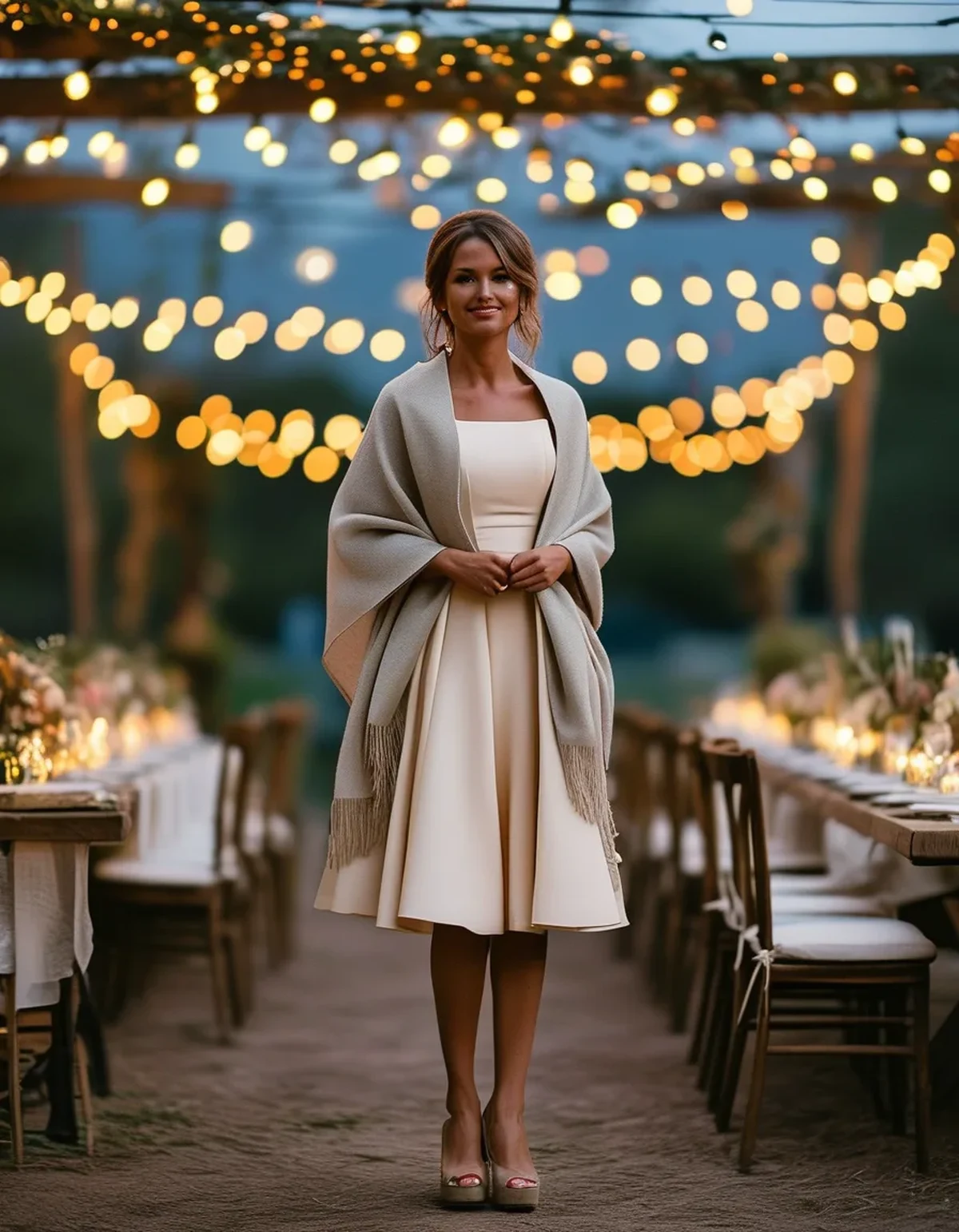
Quick Answer: Outdoor autumn receptions have a temperature swing of 10 to 15C between the ceremony and the last hour, and the mistake almost everyone makes is dressing for the photos rather than the timeline. The working formula is a midi or maxi in a fabric with body, one layer that reads as part of the outfit rather than as a coat, block or wedge heels for grass, and something for your arms that lives on the chair back. Fix the heels and the arms and the rest follows.
The difference between a good night and a long one is usually three decisions, and none of them are about the dress.
What actually goes wrong at outdoor autumn receptions?
It is rarely the thing people plan for.
The heels sink. Grass, gravel paths, and the strip between the marquee and the car park are all hostile to a stiletto. A stiletto concentrates your weight on a few square millimetres and will sink into damp ground with your full weight behind it - which is exactly what happens during the outdoor cocktail hour when you are standing still holding a drink. Block heels, wedges, and low platforms spread that load and stay on the surface.
The temperature drops faster than you expect. In late September and October across most of the US, sunset takes 8 to 12C off the air within about 90 minutes, and outdoor venues have no thermal mass to hold heat. The 4pm ceremony is genuinely warm. The 8pm dancing is genuinely cold, and heat lamps only cover the area directly beneath them.
The wind. This one is underrated. An open field with a light breeze feels several degrees colder than the same temperature in a sheltered street, and it turns a floaty fabric from elegant to unmanageable.
The bare arms problem. Most formal dresses are sleeveless, and arms are where you lose comfort first once the sun is gone. A shawl solves it, and a shawl you have to hold all night creates a different problem.
The fabric and silhouette that actually survive the night
Fabric choice does more work here than colour or cut.
Fabrics that hold up outdoors:
- Crepe - has weight, resists wind, does not crease when you sit on a chair for four hours
- Velvet - genuinely warm, reads as autumn, and hides everything
- Ponte and heavier knits - comfortable, warm, and forgiving after dinner
- Satin with some body to it, though thin satin shows every line
Fabrics that struggle: thin chiffon in wind, unlined lace against bare skin at 12C, and anything sheer that assumed indoor lighting.
Length is a comfort decision, not just a style one. Midi is the practical sweet spot - it covers the knee, which is where you feel cold sitting outdoors, and it clears wet grass. A full maxi looks wonderful and picks up mud along the hem at every outdoor venue, so if you go maxi, go with a fabric that will not show it.
On sleeves: a dress with actual sleeves solves the arms problem permanently and removes the need for a layer at all. Long-sleeved midi dresses are the single most practical autumn wedding guest garment and they are chronically under-considered because sleeveless still reads as more formal in most people’s heads. It has not been true for years.
The layer that does not look like a coat
This is the decision that separates comfortable from cold.
What works, roughly in order of usefulness:
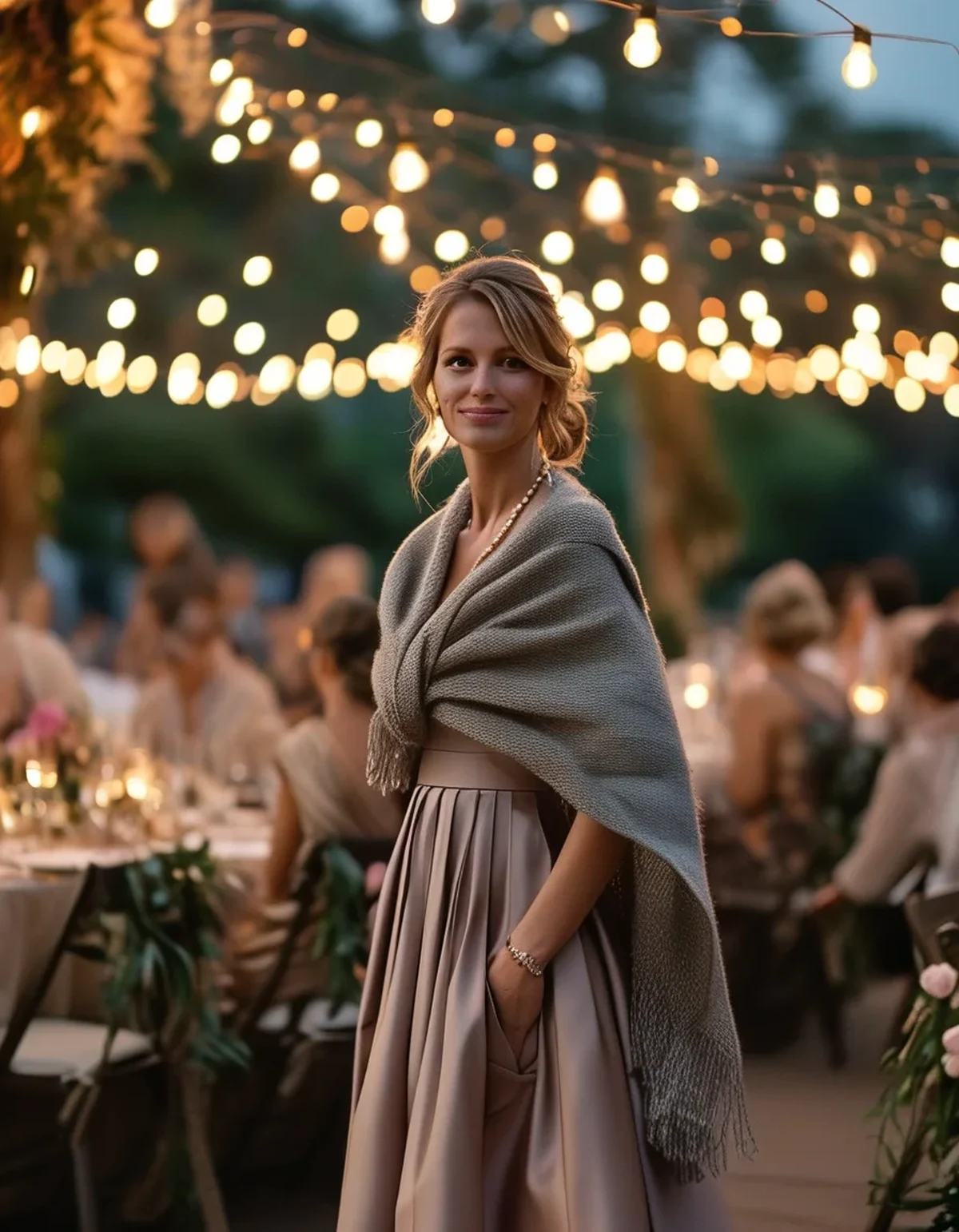
- A large wrap or blanket scarf in a fabric that matches the dress formality - cashmere blend, wool blend, or heavy viscose. It lives on the back of your chair, goes over your shoulders for the outdoor parts, and reads as intentional
- A tailored blazer, which has become genuinely acceptable at evening weddings and is warmer than any shawl
- A cropped or fitted knit cardigan in fine gauge, which works surprisingly well over a slip-style dress
- A faux fur or textured stole for very formal events, though it is a one-job item
What does not work: your everyday coat over a formal dress in photos, a pashmina you have to hold together with one hand all evening, and anything that has to come off completely for the outfit to make sense.
The test: put the layer on and look in the mirror. If the outfit looks deliberate with the layer on and also deliberate with it off, you have chosen correctly. If it only works one way, you will spend the night managing it.
And a hard-won detail: choose a layer with some structure at the shoulder if you plan to dance. A loose shawl and dancing are incompatible, and you will end up leaving it on a chair and being cold.
Myth vs Fact: Outdoor Autumn Wedding Dressing
Myth: Heat lamps mean you can dress as if it is indoors. Fact: Heat lamps warm a radius of a couple of metres and do nothing for the walk to the bar, the queue for the bathroom, or the dance floor. Plan for the coldest part of the venue, not the warmest.
Myth: Tights are too casual for a wedding. Fact: Sheer hosiery is entirely normal at formal autumn events and adds a real, measurable amount of warmth. It also solves the specific problem of cold knees under a midi.
Myth: You should bring a change of shoes. Fact: A good idea in principle and usually a disaster in execution, since the flats end up in a bag you carry all night. Better to choose one pair that works on grass from the start than to plan a shoe change you will resent packing.
Myth: Dark colours are the safe autumn choice. Fact: Autumn venues are dim and heavily lit with warm string lights, and a very dark dress can disappear entirely in photographs. Deep jewel tones, rust, olive, and burgundy photograph far better in that light than plain black does.
FAQ: Outdoor Fall Wedding Guest Questions, Answered
How do I know how cold it will actually get?
Check the forecast low for the venue location rather than the daytime high, and then subtract a couple of degrees for wind exposure in an open field. If the low is 10C and the reception runs to 11pm, you are dressing for about 10C for the last two hours, not for the 20C of the ceremony.
Are boots acceptable at a fall wedding?
A sleek ankle boot with a block heel under a midi dress is well within normal for an autumn outdoor wedding and solves grass, cold, and walking in one item. Keep the boot simple and the dress dressy and the balance works.
What about the walk from the car park?
This is the part that ruins shoes. If the venue is a farm, barn, or estate, assume a few hundred metres of gravel or grass. Wear the block heel, or genuinely commit to walking in flats and changing at the door - but only if someone else is carrying the bag.
TL;DR:
- Dress for the last hour of the reception, not for the ceremony photos
- Block heels or wedges are non-negotiable on grass; stilettos sink under standing weight
- Crepe, velvet, and ponte hold up outdoors; thin chiffon and unlined lace do not
- The layer must look deliberate on and off - a heavy wrap or a blazer beats a hand-held pashmina
- Jewel tones photograph better than black under warm string lights
A long-sleeved midi in crepe with a block heel is the outfit that solves nearly every version of this event. Check the forecast low rather than the high, and the rest of the decisions make themselves.
Keep Reading
This article is for general informational and styling purposes only. Fit, sizing, and product availability may vary.