How to Dress for an Event When You Don't Know the Venue

Quick Answer: Build from a neutral, well-fitting base — a simple dress or trousers and top in one colour — and control the formality entirely through two swappable elements: outerwear and shoes. That way a single outfit reads correctly whether the venue turns out to be a casual bar or a formal dining room, and the adjustment takes two minutes in a car or a cloakroom.
One base, two levers. That is the whole method.
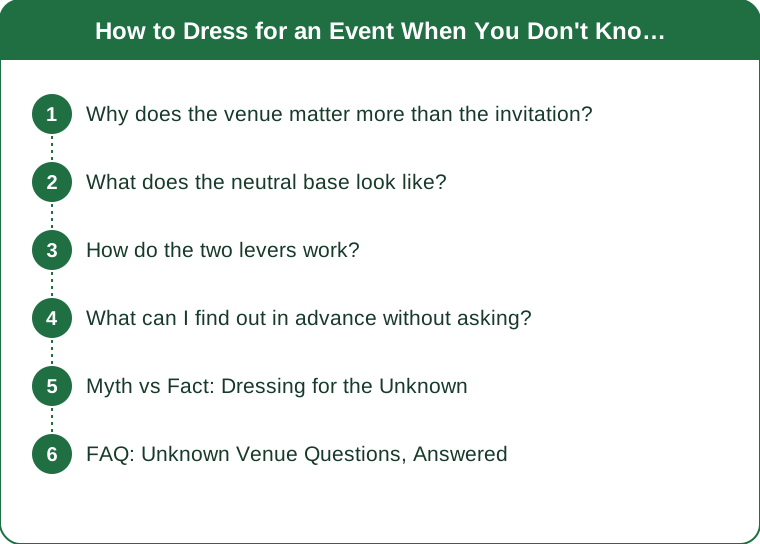
Why does the venue matter more than the invitation?
Venues set formality more reliably than dress codes do. A room’s lighting, seating, ceiling height and noise level tell guests how to behave, and people dress to match the room they find, not the words on the invitation.
Temperature is the practical issue. A converted warehouse in late September is a completely different thermal environment from a heated private dining room, and this is where most outfit regret comes from.
Seated or standing changes everything. A standing event needs shoes you can hold for three hours; a seated one needs a waistband and a hem that work sitting down.
Photography varies enormously. Warm restaurant lighting flatters almost everything; harsh overhead lighting in a function room does not, and heavily textured or very shiny fabrics behave unpredictably under it.
What does the neutral base look like?
One colour, well fitted, minimal detail. A dark dress, or trousers with a matching or tonal top. Monochrome reads as more formal automatically and photographs consistently under any lighting.
Choose fabric with a little weight. Heavier fabric drapes better, sits still when you move, and photographs cleanly. Very lightweight fabric wrinkles in a car and clings in a warm room.
Avoid the very specific pieces. Anything with a strong statement — a bold print, a dramatic sleeve, a distinctive texture — locks the formality level in place and removes your ability to adjust.
Fit it seated. Sit down in it at home for two minutes. Almost all event outfit discomfort is a seated problem discovered standing up.
Late-summer note: an outfit chosen in an August heatwave for a late-September event is frequently wrong. Check the forecast the day before rather than trusting the version of the weather you had in mind when you bought it.
How do the two levers work?
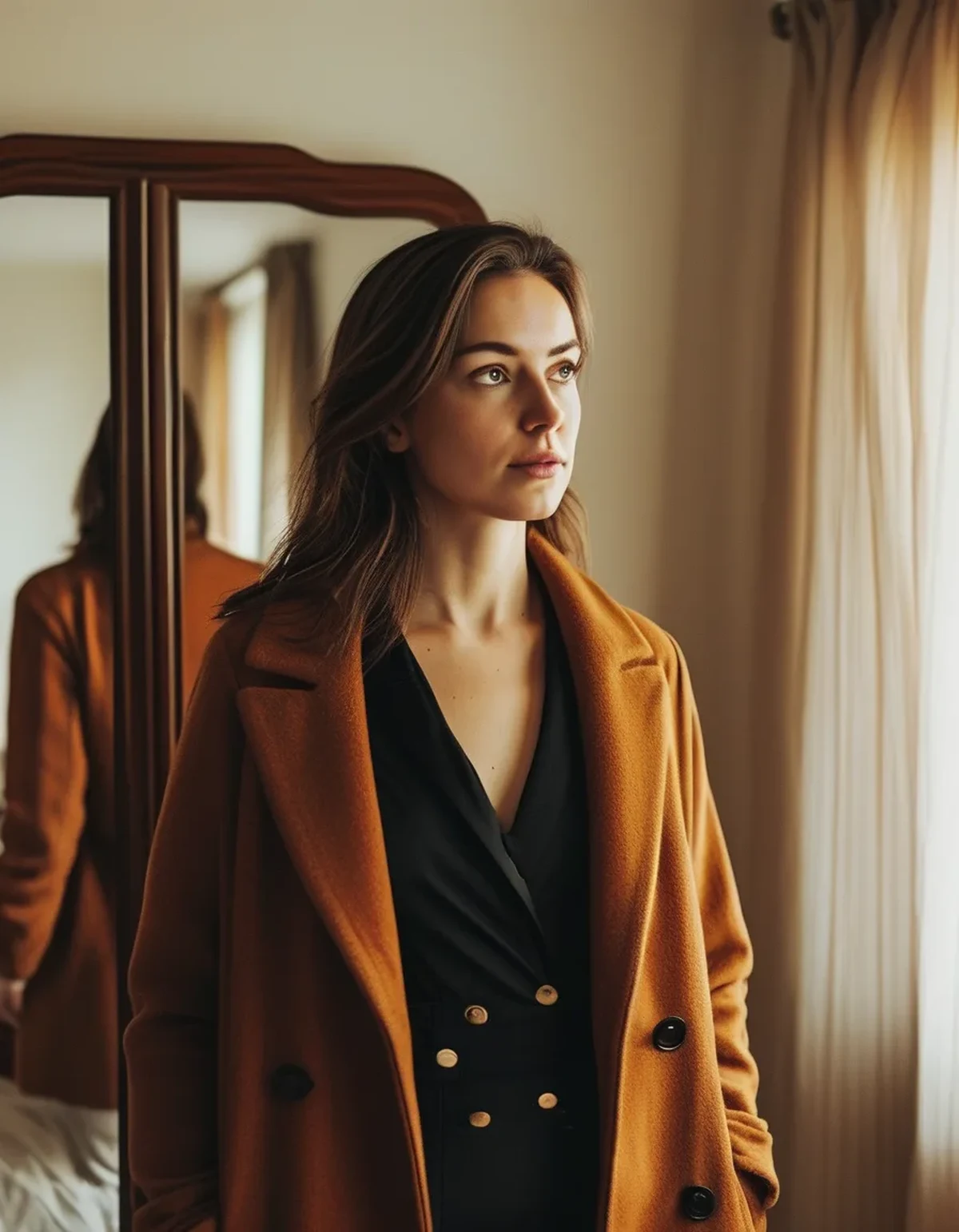
Outerwear is the formality dial. A tailored blazer reads business or smart; a leather or suede jacket reads casual; a wrap or a fine knit reads relaxed-elegant. The same base underneath moves a full level in either direction.
Shoes are the second dial and the more visible one. A clean flat or loafer reads casual, a low block heel reads smart, a heel or a metallic reads formal. Nobody notices the jacket first; they notice the shoes.
Bring one of each in the car if you can. A second pair of shoes and an alternative jacket in the boot solves this entirely and costs you nothing.
Jewellery is a third, smaller dial. Adding one substantial piece raises formality noticeably; removing it drops it back. Keep it in a pocket rather than deciding at home.
Do not use makeup as the lever. It is the hardest to adjust on site and the least visible in a dim room.

What can I find out in advance without asking?
Look at the venue’s own photographs, not the event’s. Venue websites show the room, the lighting and the seating, which is most of what you need.
Check the address type. A hotel, a members’ club, a restaurant and an event space each have a default formality, and the postcode tells you more than the invitation.
Ask one other guest, casually. A single message — “any idea how dressy this is?” — is normal and gets you a real answer.
Check the start time. Events starting after 7pm skew more formal than the same event at 5pm, consistently.
Look at whether food is seated or standing. A sit-down dinner is almost always a level up from a drinks reception at the same venue.
Myth vs Fact: Dressing for the Unknown
Myth: Overdressed is always safer than underdressed. Fact: Being significantly overdressed is just as uncomfortable, and it is harder to fix on site. Being one small notch above the room is the actual target.
Myth: Black is always appropriate. Fact: Black is reliably appropriate and can read as severe in a warm, casual daytime venue. Deep navy, charcoal and rich neutrals do the same job with more range.
Myth: You should decide the whole outfit at home. Fact: Deciding the base at home and the levers on arrival is a better system, and it is what people who always look right at events are actually doing.
Myth: Uncomfortable shoes are the price of a good outfit. Fact: Discomfort visibly changes how you stand and move, and it shows in photographs. A shoe you can wear for the whole event is a better-looking shoe.
Myth: Nobody notices what you wear. Fact: People notice how you carry it far more than what it is, which is exactly why comfort and fit outperform novelty and expense.
FAQ: Unknown Venue Questions, Answered
What if I arrive and I am clearly wrong?
Adjust with the levers, then stop thinking about it. Visible discomfort about an outfit registers with other people far more strongly than the outfit itself.
Is there a fabric that works for every venue?
A mid-weight crepe, ponte or fine wool handles temperature swings, wrinkles least, and photographs cleanly under most lighting. Those three properties matter more than the specific fibre.
How do I handle no coat check?
Assume there is none. Carry outerwear you are happy to keep on or hold, and skip anything bulky you would resent carrying for four hours.
TL;DR:
- Build one neutral, well-fitted, single-colour base and adjust with outerwear and shoes.
- Keep a second jacket and second pair of shoes in the car for on-site adjustment.
- Venue photos, address type, start time and seated-versus-standing tell you almost everything.
- Aim one small notch above the room, not several.
- Test the outfit seated at home; that is where the failures are.
Stop trying to guess the room. Build an outfit that fits all of them.
Keep Reading
This article is for general informational and styling purposes only. Fit, sizing, and product availability may vary.