What to Wear to a Fall Event When the Venue Has No Coat Check

Quick Answer: Without a coat check, your outer layer is either worn all night or carried all night — so choose one that works as part of the outfit rather than over it. The reliable move is a structured jacket or a heavy knit you’d wear indoors anyway, plus a warm underlayer for the trip there. Save the actual winter coat for events where somebody takes it from you at the door.
You planned the outfit. You did not plan for holding a wool coat in your left arm from 7pm to 11pm.
It’s the most common fall event failure, and it’s entirely predictable — which means it’s entirely preventable.
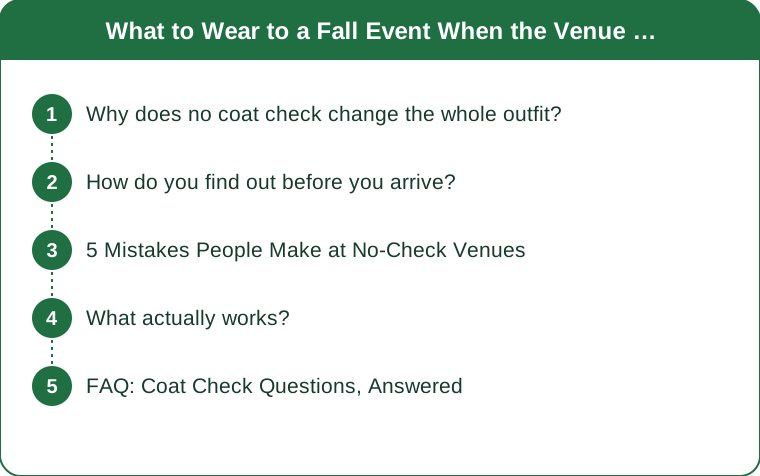
Why does no coat check change the whole outfit?
Because it converts your outer layer from transport gear into wardrobe, and those have opposite requirements.
A coat built for the walk from the car is designed for warmth and weather. It’s usually bulky, often longer than your dress, and rarely chosen with the outfit underneath in mind — because normally nobody sees it past the door.
Without a check, you get three options and each has a real cost:
Wear it all night. Fine if it works as part of the outfit. Overheating and looking overdressed for indoors if it doesn’t.
Carry it all night. You lose an arm. No plate, no glass, no hug that isn’t awkward. Every photo has a coat in it.
Pile it somewhere. On a chair back, in a corner, under a table. It wrinkles, it may end up under other people’s coats, and you’ll spend part of the night wondering where it went.
None of these are catastrophic. But they’re all worse than the fourth option, which is choosing an outer layer you’d be happy to keep on.
How do you find out before you arrive?
Most people find out at the door. There are better ways.
The invitation often tells you indirectly. A private home, a restaurant’s back room, a brewery, a rooftop, a converted warehouse, or anything described as intimate almost certainly has no coat check. Hotels, formal event halls, and larger clubs usually do.
Ask the host. For a private event, a one-line text is completely normal and takes ten seconds: is there somewhere to put coats? Hosts would rather answer it than have twelve coats on their bed.
Check the venue’s own photos. Restaurant and event-space websites show their entryways. If there’s no closet or attendant stand in frame, assume there isn’t one.
Look at the seating. A standing reception is the hard case, because there’s no chair back to drape anything over. Seated dinners give you a chair, which quietly solves most of the problem.
Default assumption: for fall and holiday events at smaller venues, assume no coat check unless you’ve confirmed otherwise. You’ll be right most of the time and you’re never worse off for having planned around it.
5 Mistakes People Make at No-Check Venues
1. Wearing the warmest coat you own for a 4-minute walk. The trip from the car doesn’t require your winter coat if the rest of the outfit is warm. Dress the underlayers warmer and the outer layer lighter, and the outer layer becomes something you can keep on.
2. Choosing a coat that’s longer than the dress. If the coat has to come off for the outfit to make sense, you’ve committed to carrying it. A jacket that ends at or above the hem of what’s underneath stays on comfortably.
3. Forgetting the arrival is the coldest part of the night. You’ll be outside, possibly waiting, possibly in wind, at your least warmed-up. Then you’ll be indoors in a crowded room that runs 10 degrees warmer than you expected. Plan for both, not just the second.
4. Bringing a bag too small to hold anything you shed. A scarf, gloves, and a hat all need to go somewhere at some point. A bag that fits them is worth more than one that photographs better.
5. Assuming a wrap counts as warm. A thin wrap or pashmina is a styling piece, not insulation. It’s a fine choice if the walk is genuinely short and the car is warm — but it doesn’t replace an actual layer in October, and it slides off your shoulders every twenty minutes.
What actually works?
Three approaches, depending on the event.
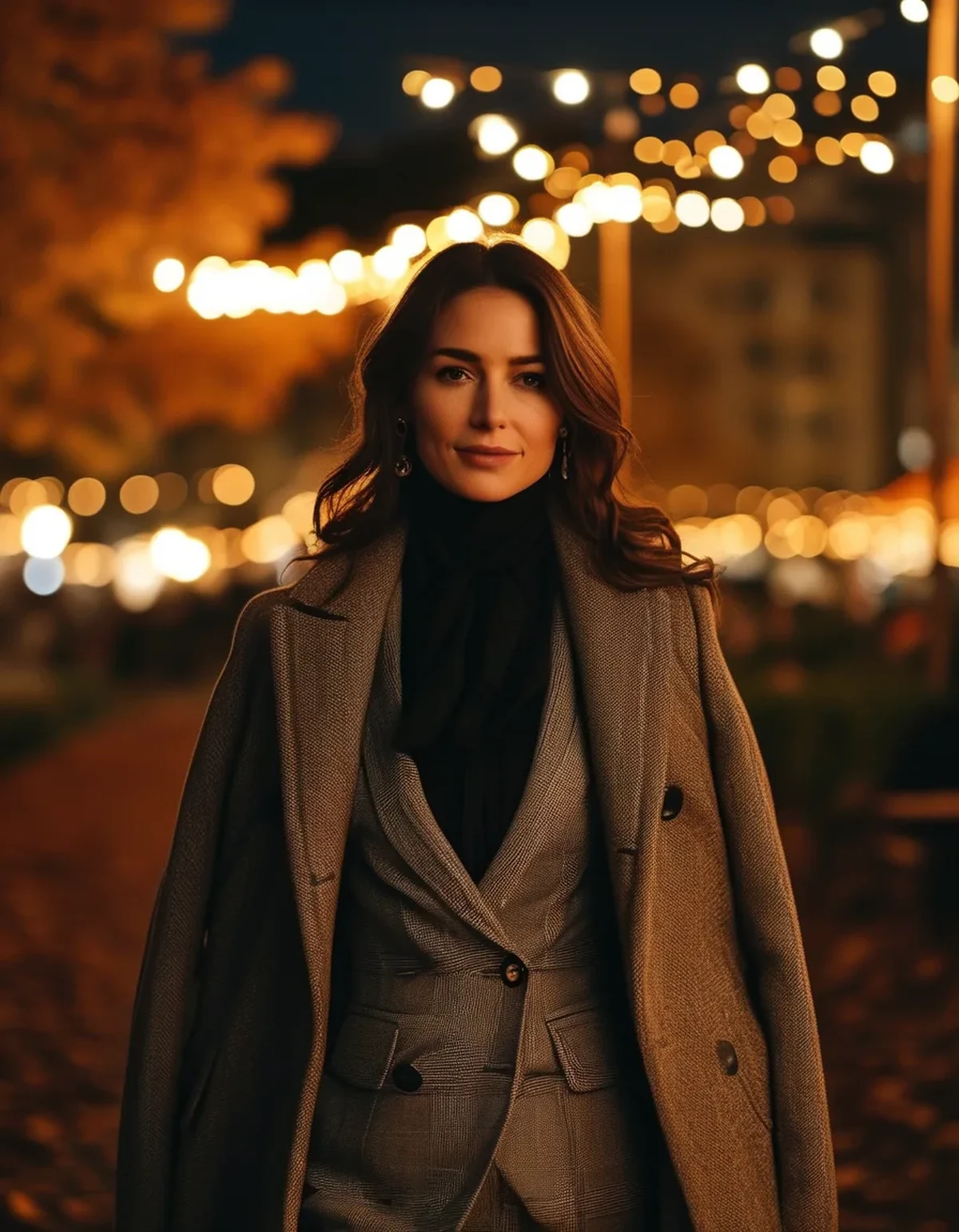
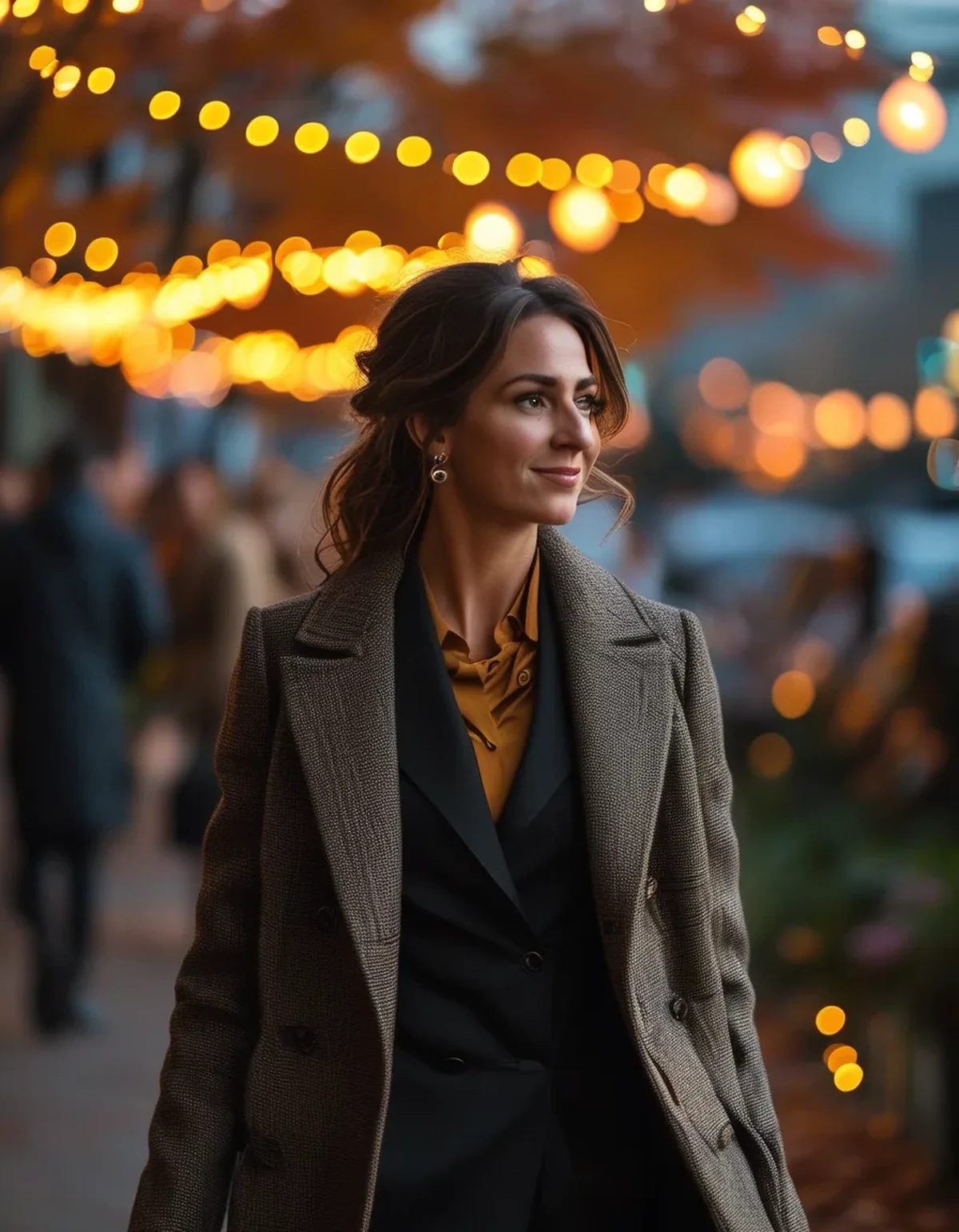
The structured jacket. A tailored blazer, a leather or suede jacket, or a well-cut cropped jacket in a fabric that reads finished. It’s warm enough for a short walk, appropriate indoors, and if you do take it off it hangs neatly on a chair back without wrinkling. This is the most flexible option and the one to default to.
The heavy knit as the outfit. A substantial sweater or knit dress that is the top layer, worn with nothing over it beyond the car. Works well for casual and semi-formal events and eliminates the problem entirely, because there’s nothing to remove. Fabric weight is what makes this work — a fine-gauge knit won’t carry the evening.
The full coat, planned for. If it’s genuinely cold and you need a real coat, choose one that photographs well and plan where it will live. At a seated dinner it goes over your chair back — arrive early enough to get a chair on the end rather than the middle. At a standing reception, ask the host directly on arrival; there’s usually a bedroom or back room, and asking is far better than guessing.
Temperature note for a fall evening: most indoor venues run warm once they fill with people, and a room that felt fine at 7pm is noticeably warmer by 9. Build the outfit so the layer you keep on is one you’d wear in a warm room. That single constraint solves nearly everything else.
FAQ: Coat Check Questions, Answered
Is it rude to ask the host where to put my coat?
Not remotely. It’s one of the most common questions at a private party and hosts almost always have a plan. Asking on arrival is better than improvising later — and better than a guest quietly putting a coat somewhere the host didn’t intend.
What if I’m cold all night in just a jacket?
Fix it with the underlayers rather than the outer one. A thermal base layer, tights under a dress, or a warmer fabric weight solves it invisibly and doesn’t add anything you have to manage. Rooms full of people warm up fast anyway.
Can I leave my coat in the car?
If parking is close and secure, that’s often the cleanest answer — wear it in, and if the room is warm, walk it back out. Not worth it if parking is far, street-side, or the walk is unlit.
TL;DR:
- No coat check means your outer layer is worn or carried all night — so choose one you’d happily wear indoors.
- Assume no coat check at private homes, restaurants, breweries, and rooftops unless you’ve confirmed otherwise.
- Dress the underlayers warmer and the outer layer lighter, so the outer layer works as part of the outfit.
- A structured jacket is the most flexible answer; a heavy knit that is the outfit removes the problem entirely.
Before your next fall event, spend the ten seconds to ask or check the venue photos. It’s the difference between an outfit you planned and an outfit you’re managing all night.
Keep Reading
This article is for general informational and styling purposes only. Fit, sizing, and product availability may vary.