Dressing for Early-Fall Events When It's Warm Outside and Freezing Indoors

Quick Answer: Early-autumn events have a 10 to 15°F swing between outdoors and indoors, and the buildings are still running summer air conditioning. Dress for the indoor temperature and add one removable outer layer for outside — the opposite of what most people do. Fabric choice matters more than layer count: a single mid-weight natural fiber handles the swing better than two thin synthetic layers, because it insulates when still and breathes when moving.
You arrive warm and slightly damp from the walk, and forty minutes later you’re holding your arms across your chest under a vent.
This is the most predictable dressing failure of the season, and it comes from solving for the wrong half of the evening.
Why does this specific season cause so many problems?
Because buildings and weather are out of sync, and the mismatch peaks in September and October.
Commercial HVAC systems switch from cooling to heating on a schedule, not on a thermostat. Many buildings run air conditioning well into October regardless of outdoor conditions, so an event space can genuinely be colder inside than out.
Venues run cold deliberately for events. A room full of people generates significant heat, and venues pre-cool to compensate. The room is at its coldest when you arrive and warmest an hour in — which is exactly backwards from what you dressed for.
Evening temperature drops are steepest in early autumn. The gap between a 6pm arrival and an 11pm departure can be 15 to 20°F, larger than in summer or in deep winter.
And you arrive warm. Walking, parking, and stress all mean you enter a venue with elevated body temperature, so the room feels comfortable for the first ten minutes and cold for the next two hours as you cool down.
The dressing consequence: solving for the arrival moment guarantees discomfort for the majority of the event.
What should the base layer actually be?
Dress the core of the outfit for the indoor temperature — around 66 to 68°F — and treat outside as the exception.
You’ll spend 90% of the evening indoors. Every minute of comfort optimization should go there. The walk from the car is five minutes and is solvable with a coat.
Mid-weight natural fibers do the most work. A ponte, a crepe, a fine wool knit, or a heavier silk blend insulates when you’re seated and breathes when you’re moving in a way that thin polyester simply doesn’t.
Sleeves are the highest-value decision. A three-quarter or long sleeve in a light fabric handles a cold room far better than a sleeveless dress plus a wrap you have to hold. The wrap always ends up on a chair.
Avoid thin synthetic linings against the skin. They trap the sweat from the walk in and then hold it cold against you for the rest of the evening — this is the specific mechanism behind feeling clammy and chilled simultaneously.
Check the seated version. Sleeveless is colder when seated because your arms aren’t moving and the shoulders are exposed to overhead vents. Try the outfit sitting down before you commit.
How do I handle the layer without carrying it all night?
Choose layers that are part of the outfit rather than additions to it.
A structured blazer or a tailored jacket reads as intentional and stays on. It’s the most reliable solution, because it doesn’t need to be removed to look right, and it doesn’t need holding.
A knit that matches or coordinates, worn over the dress rather than draped, does the same job with a softer look.
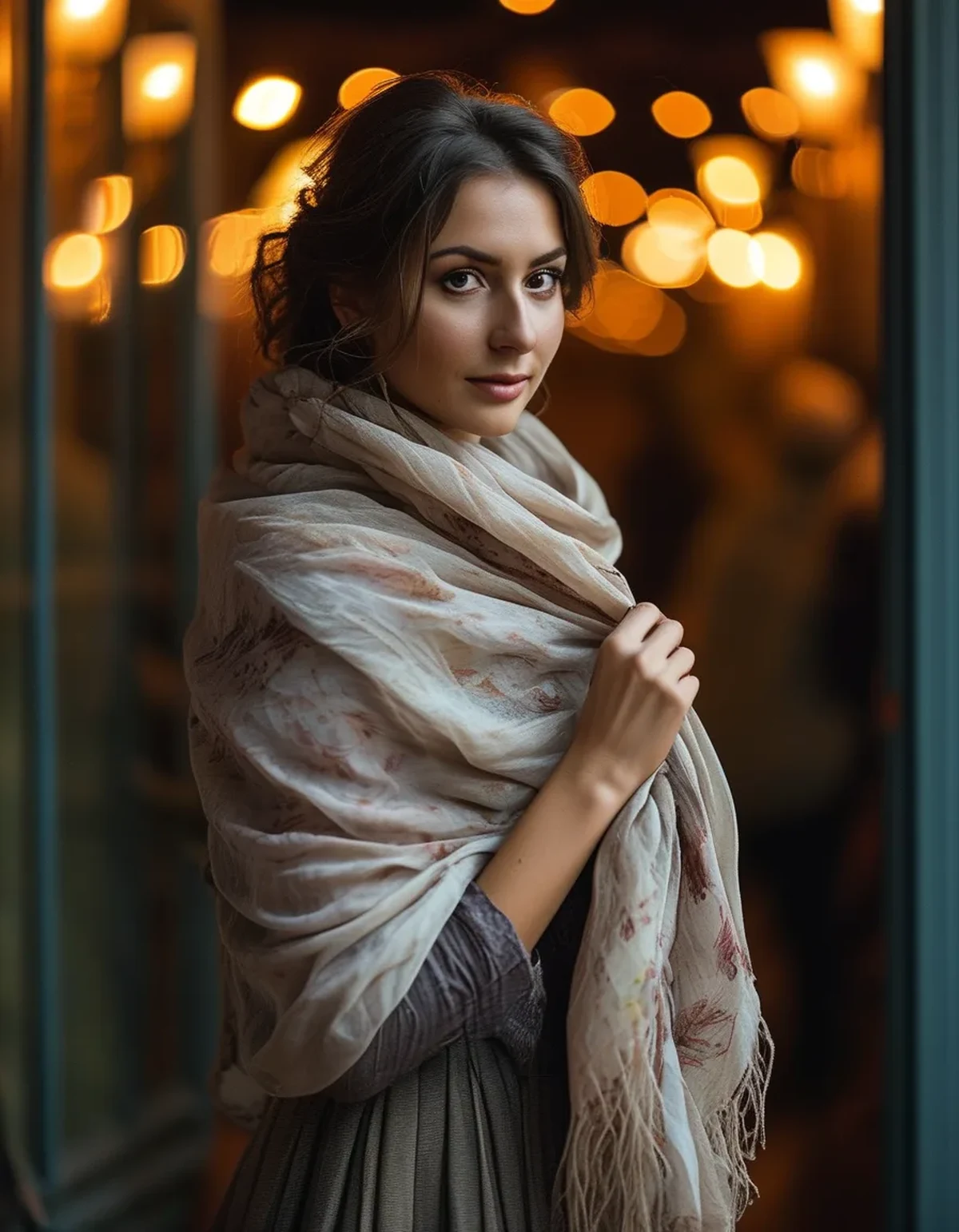
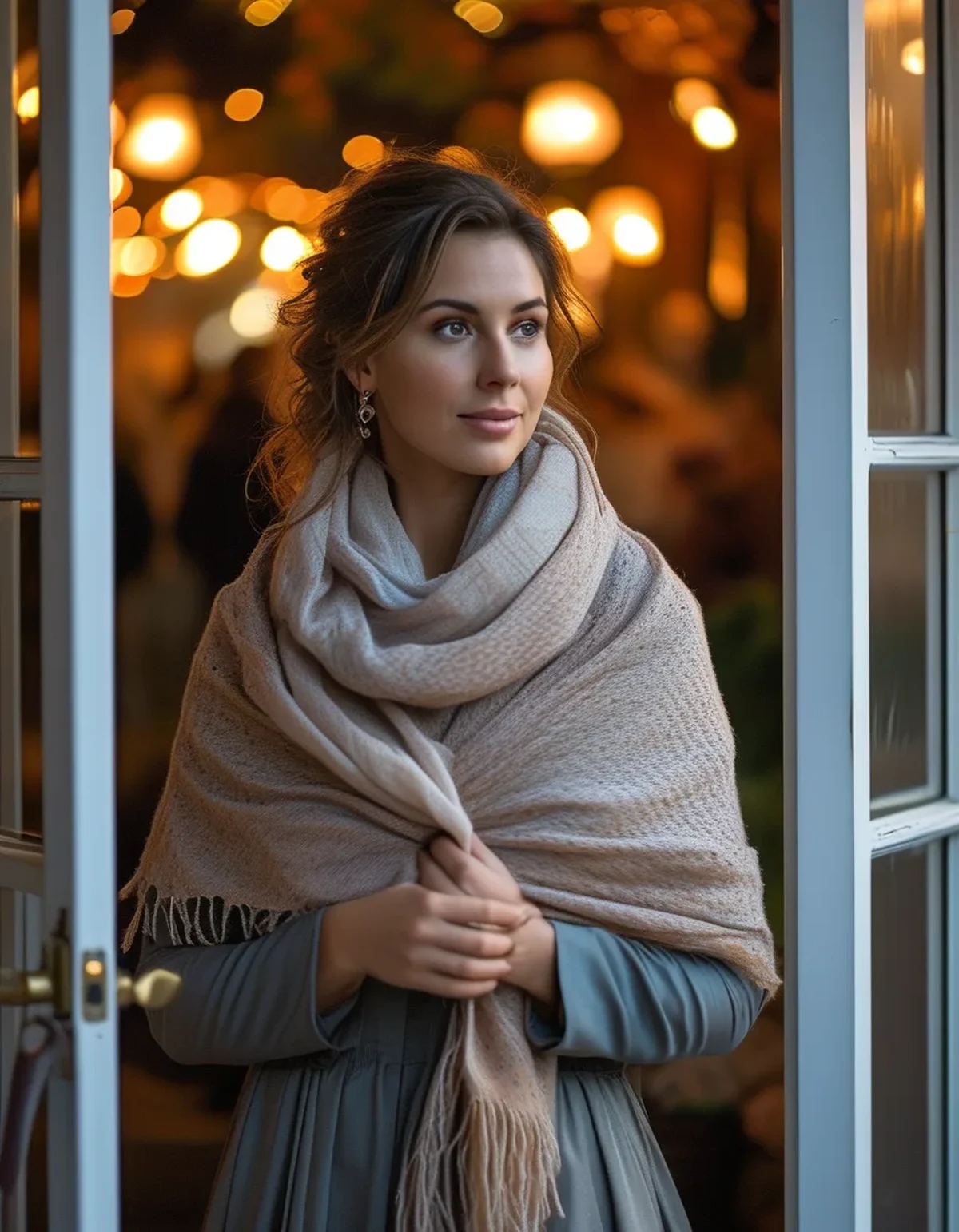
Wraps and pashminas fail predictably. They require a hand, they slip, and they end up on the back of a chair within twenty minutes. If you love the look, pin it — a small brooch or a hidden safety pin converts a wrap from a liability into a garment.
Coats should be checkable or leave-in-the-car. The outer layer for the walk in should be one you’ll take off immediately, which means it can be much warmer than the rest of the outfit and doesn’t need to coordinate perfectly.
Hosiery is the invisible layer nobody counts. Sheer tights add a real amount of warmth and change the outfit less than any other layer. In a cold venue they’re often the difference between fine and uncomfortable.
Closed-toe shoes over open in October. Feet get cold first when seated, and it’s the temperature complaint people least expect.
Myth vs Fact: Transitional Season Event Dressing
Myth: More thin layers is more adaptable. Fact: Thin layers trap moisture and add bulk without much insulation. One mid-weight layer usually outperforms two thin ones and looks considerably better under a jacket.
Myth: You should dress for the weather forecast. Fact: The forecast describes five minutes of your evening. Dress for the venue and manage the transit — and if you don’t know the venue, assume it’s cold, because venues almost always are.
Myth: Sleeveless with a wrap is the flexible option. Fact: It’s the option that most reliably ends with you cold and holding fabric. A light long sleeve is more flexible in practice because it requires no management.
Myth: Natural fibers are too warm for early autumn. Fact: Wool and silk regulate temperature in both directions — they’re the fibers that handle a 15°F swing best, which is precisely the problem you’re solving. Lightweight wool is a genuinely transitional fabric, not a winter one.
Myth: You can just ask them to turn the air conditioning down. Fact: You can ask, and it rarely happens — event HVAC is usually set centrally and adjusts slowly. Plan for the room you’ll get, not the one you’d prefer.
What’s the formula that actually works?
Four parts, and it works across almost every early-autumn event.
One: a mid-weight base garment with sleeves, in a natural or natural-blend fabric, in a color that works for the season. This is the outfit.
Two: one integrated layer — blazer, structured jacket, or a coordinating knit — that looks correct both on and off. This handles the cold room without needing management.
Three: a separate transit coat that gets removed at the door. This can be as warm as the walk requires, because nobody sees it during the event.
Four: hosiery and closed shoes, which handle the two coldest points when seated.
Then check three things before you leave. Sit down in it — most cold-venue problems appear only when seated. Raise your arms — a sleeve that binds while standing will be miserable at a table. Look at it in the mirror with the layer off, because you will take it off at some point in the evening.
One practical addition: if the event is outdoors in part — a terrace, a garden, a walk between buildings — that’s the case where the wrap earns its place, because it lives on the chair indoors and comes with you outside.
FAQ: Early Fall Event Outfit Questions, Answered
How do I find out how cold a venue runs?
Ask the host or check recent reviews and photos — people mention it constantly. Hotel ballrooms and conference centers run coldest; restaurants and smaller private rooms run warmer. When in doubt, assume cold.
Are open-toe shoes wrong in early autumn?
Not at all through September in most regions, and it depends more on the venue and the event than the calendar. Feet do get cold when seated for hours, so if the event involves a long dinner, closed-toe is the more comfortable choice.
Can I wear summer dresses into fall?
With a change of fabric weight around them, generally yes. A summer-weight dress with tights, a structured jacket, and closed shoes reads as autumn. A summer dress alone reads as summer regardless of the date.
What colors work for the transitional window?
This is less rule-bound than it used to be. Deeper and warmer tones read seasonally, but a light dress with autumn-weight layering and shoes works fine. Fabric weight communicates season more reliably than color does.
How do I stop arriving sweaty from the walk?
Leave the outer layer in the car or carry it rather than wearing it, leave five minutes earlier so you’re not rushing, and choose a breathable base fabric. Most of the arrival dampness comes from a warm coat worn during exertion.
TL;DR: Solve for the two hours indoors, not the five minutes outside.
- Venues run 10 to 15°F colder than outdoors in early autumn, and they pre-cool before guests arrive.
- Dress the outfit for 66 to 68°F and treat the walk in as the exception, not the design constraint.
- One mid-weight natural fiber beats two thin synthetic layers. Wool and silk regulate in both directions.
- Sleeves outperform a wrap. The wrap always ends up on a chair by minute twenty.
- Use an integrated layer that looks right on and off — a blazer or coordinating knit — plus a separate transit coat.
- Hosiery and closed shoes handle the two places that get cold first when seated.
Before the next event, sit down in the outfit for five minutes. That single test catches almost everything the mirror misses.
Keep Reading
This article is for general informational and styling purposes only. Fit, sizing, and product availability may vary.