Buying Your Holiday Outfit Early: What Actually Holds Up

Quick Answer: Buy structured pieces early and stretch-dependent pieces late. Blazers, tailored trousers, skirts, and anything with a defined waist seam are stable purchases in August because they fit the same in December. Bodycon knits, anything relying heavily on elastane, and shoes are the risky ones, because your body composition, the fabric’s recovery, and your tolerance for standing all change across four months. The other rule that saves money: buy for the venue temperature, not the season’s mood.
Holiday collections hit the floor in late August, and the discounts in September are the best they will be all year.
They are also the reason a lot of people own a perfectly nice dress they wore once, or never. Buying early is a good strategy applied to the wrong categories.

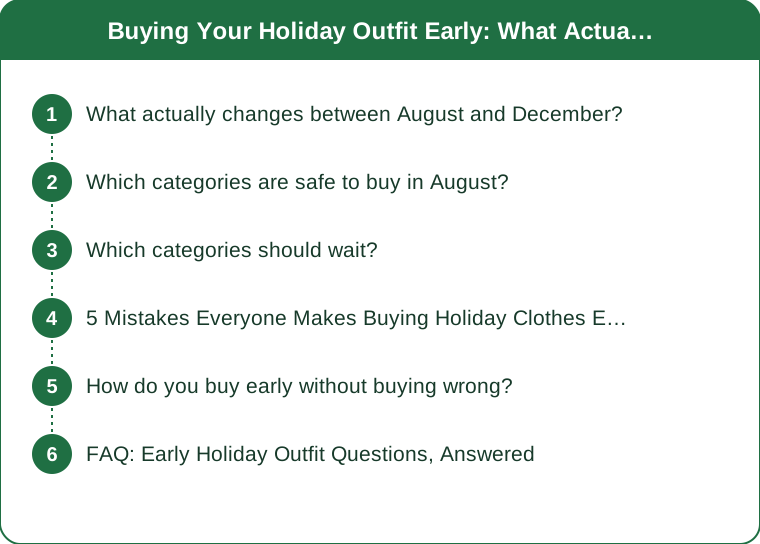
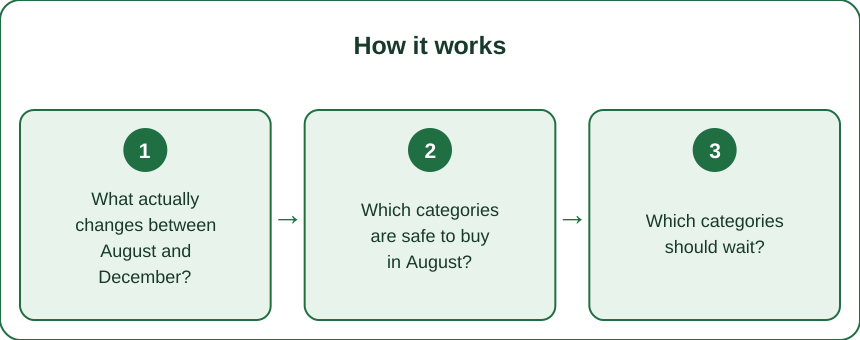
What actually changes between August and December?
Four things, and only two of them are about your body.
Your body composition may shift. Not dramatically for most people, but a few pounds in either direction changes how a rigid, fitted garment sits and changes almost nothing about how a structured or draped one sits. This is the whole basis of the buy-structured-early rule.
Your baseline body temperature adaptation changes. In August you are heat-adapted, and a sleeveless dress feels normal. By December you have re-acclimated to cold and the same dress in the same room feels colder than it did. People consistently under-buy warmth in August.
The fabric changes if it is stretch-dependent. Elastane degrades with time and heat, and a piece that sat in a warm closet for four months has lost a small but real amount of recovery before it is ever worn. On a rigid fabric this is irrelevant. On a bodycon knit it is the difference between snug and slouchy.
Your event context changes, and you do not know it yet in August. You are buying for an imagined party. The actual invitation might be a cocktail thing at 6pm, a standing reception, or a family dinner where you will be sitting for three hours. These want very different clothes.
Which categories are safe to buy in August?
Anything where fit is delivered by structure rather than by stretch.
Blazers and tailored jackets. These fit through shoulder and sleeve, which are the most stable measurements on your body. A blazer that fits in August fits in December with near certainty. Also the highest-value early buy, since good tailoring is where holiday discounts are shallowest later.
Tailored trousers and structured skirts. Anything with a defined waistband and a lining. The lining is doing the work, and lining does not stretch out in a closet.
A-line and fit-and-flare dresses. These are fitted at one point, usually the natural waist, and forgiving everywhere else. One stable measurement is much safer than five.
Outerwear. Coats fit over layers, so a small body change is absorbed. And buying a coat in August is genuinely the cheapest it will be.
Accessories and bags. Obviously stable, and this is where early-season discounting is often deepest because retailers are clearing to make room.
Which categories should wait?
Anything where the fit relies on stretch, or on how you will feel on the night.
Bodycon and heavily stretch-dependent knits. They fit exactly one body and have the least margin. Four months is enough for both the body and the fabric to move.
Anything strapless or with structural boning. These need to fit your ribcage precisely. There is no give and no adjustment.
Shoes, and this is the one people get wrong most expensively. Foot volume changes with the season, you will be wearing different hosiery in December than you tried them on with in August, and, most importantly, you cannot evaluate a shoe you will stand in for four hours by walking across a store carpet for ninety seconds. Buy occasion shoes close to the event, and buy them in the afternoon.
Anything you are buying because it is beautiful rather than because you know where you will wear it. The August version of you is shopping a fantasy season. The December version has a specific invitation with a specific dress code and a specific room temperature.

5 Mistakes Everyone Makes Buying Holiday Clothes Early
1. Buying for the season’s mood instead of the venue’s temperature. Holiday collections are styled for imagined snowy evenings. Most actual holiday events happen in overheated rooms with 40 people in them. Sleeveless with a layer you can remove beats a heavy long sleeve almost every time.
2. Buying the statement piece and none of the pieces around it. You buy the dress in August, and in December you discover you have no coat that works over it, no shoes that suit it, and nothing to wear it with when the room is cold. The dress was 40 percent of the outfit.
3. Trying on in a cool, empty fitting room in the morning. That is the most flattering possible set of conditions and the least representative. Your December self will be warmer, later in the day, and will have eaten.
4. Not checking the return window against the event date. August purchases routinely fall outside the return window by the time you can actually assess them against a real invitation. Check the window before you buy, and note the last return date somewhere you will see it.
5. Buying one outfit for one night. The highest-value holiday purchase is a piece that works for three different events at three different formality levels. That is almost always a structured piece, not a statement one.
The fourth one costs people the most money and nobody thinks about it in the moment.
How do you buy early without buying wrong?
A short process that takes about twenty minutes and prevents most of it.
Step one: write down what you actually attended last year. Not what you imagined. The literal list. Most people find they went to two or three things, and one of them was considerably more casual than they remember.
Step two: identify the gap, not the want. Do you own a blazer that works for an evening event? A coat that fits over a dress? Shoes you can stand in? The gap is what to buy in August. The want can wait until November when you know more.
Step three: buy structure now, buy stretch later. The full rule from earlier, applied.
Step four: try on in the afternoon, in a warm room, after eating. This is the closest you can get to December conditions in August, and it will change your size choice on at least one item.
Step five: note the return deadline in your calendar the day you buy. Then set a second reminder a week before it, to actually try the piece on with the shoes and layers you plan to use. This one step catches almost every early-buy mistake while you can still fix it.
Right now, in early fall specifically: this is the window where last year’s occasion stock is being cleared while this year’s is arriving at full price. The clearance rack is where the structured pieces are, and structured pieces are exactly what does not date.
FAQ: Early Holiday Outfit Questions, Answered
Is it actually cheaper to buy holiday clothes in August?
For outerwear and last-season occasion pieces, meaningfully so. For current-season statement dresses, no, since those hold price until December markdowns.
What if I lose or gain weight before the event?
This is exactly why structured pieces are the safe early buy. A blazer or A-line dress absorbs a few pounds. A bodycon knit or boned bodice does not.
When should I buy occasion shoes?
Within a few weeks of the event, tried on in the afternoon with the hosiery you will actually wear. Shoes are the category where early buying goes wrong most expensively.
TL;DR:
- Buy structured early: blazers, tailored trousers, lined skirts, A-line dresses, coats. Their fit does not move.
- Buy stretch-dependent and shoes late: bodycon knits, boned bodices, and anything you will stand in for four hours.
- Dress for the venue temperature, not the season’s imagery. Most holiday rooms are overheated.
- Try on in the afternoon, warm, after eating. It is the closest thing to December conditions available in August.
- Log the return deadline and set a reminder a week early to test the full outfit.
Early buying is a good strategy. It just belongs to the half of your wardrobe whose fit is built in rather than stretched into.
Keep Reading
This article is for general informational and styling purposes only. Fit, sizing, and product availability may vary.